GeoDIQA OCR
Project
08 / 16
Website
Scope
AI workflow design | Full-stack prototype
Status
Archived Project
Summary
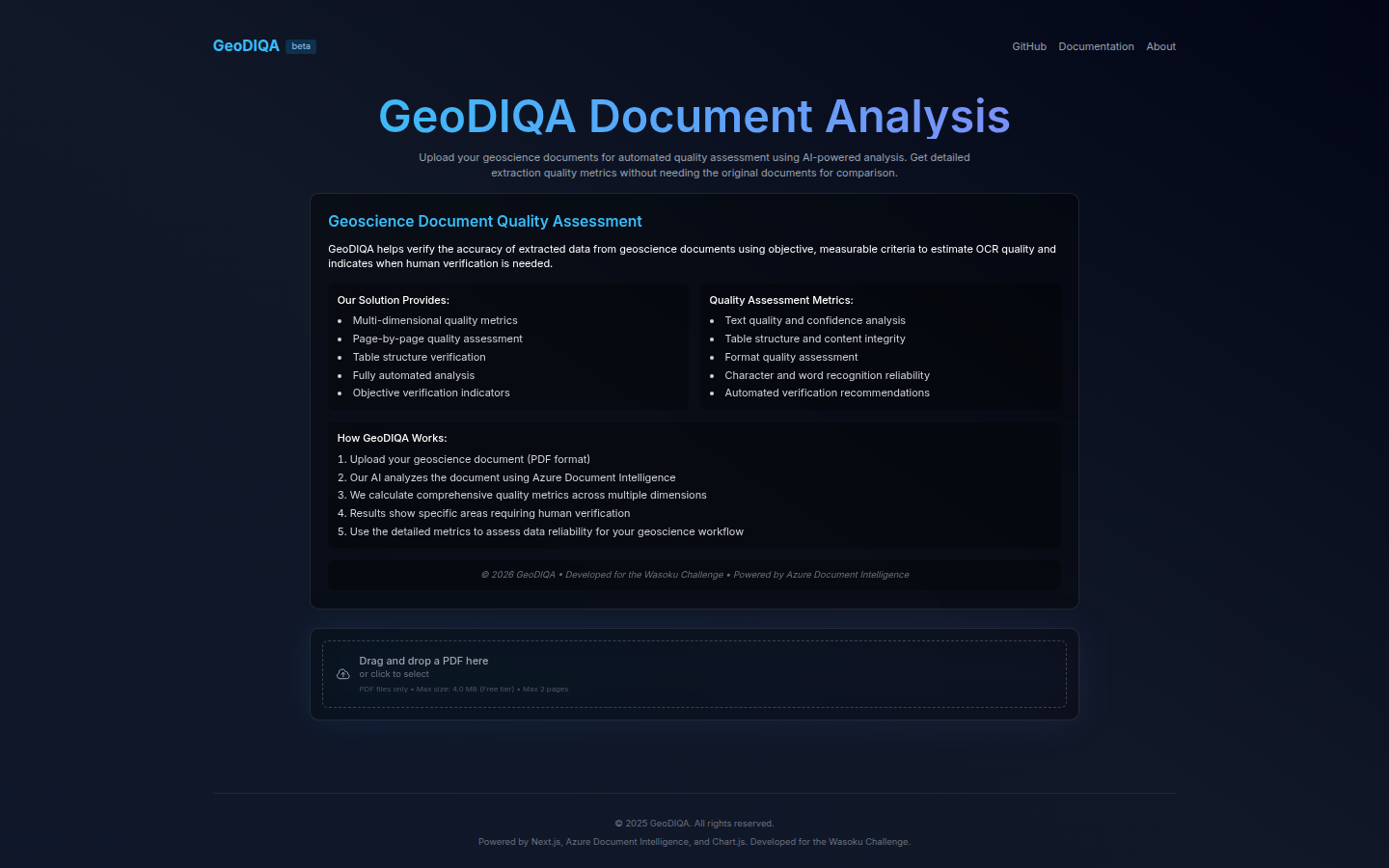
GeoDIQA responds to a difficult document-intelligence question: how can a team judge OCR quality when the original ground-truth text is unavailable? The prototype accepts scanned geoscience PDFs, analyzes the extracted layout, and turns low-level model signals into inspectable quality scores that support reviewer decisions.
The result view separates overall quality from text, table, format, and page-level evidence. Low-confidence words, incomplete or malformed tables, handwriting, rotated text, and other issue patterns contribute to a human-verification decision, giving specialists a clearer reason to accept, review, or reject an extraction.
Inside the Build
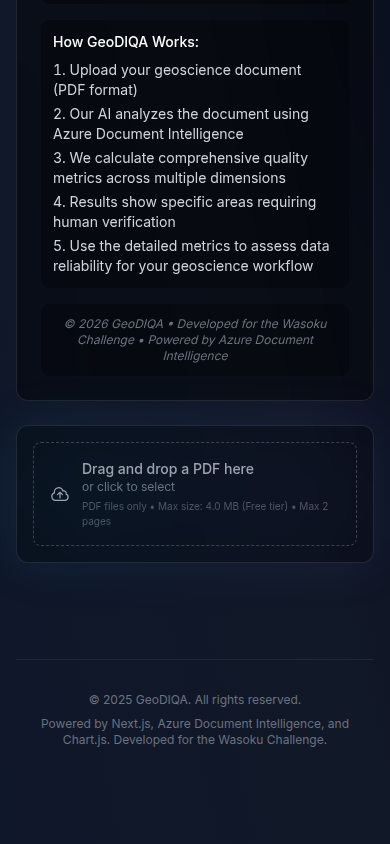
GeoDIQA validates PDF type, file size, service tier, and page limits through a Next.js API route before sending the document to Azure Document Intelligence's prebuilt layout model. The service processes words, lines, spans, pages, and tables, then calculates confidence, completeness, structure, formatting, and issue metrics from the returned analysis.
GeoDIQA manages upload, processing, failure, and results states, then visualizes the output with quality cards, detailed breakdowns, page statistics, and verification recommendations. Proposed machine-learning extensions remain separate from the implemented scoring pipeline, keeping the prototype's current capabilities clear.
Contribution
- I designed an OCR-quality model for cases without ground-truth text
- I integrated Azure Document Intelligence through a validated upload API
- I calculated text, table, format, and page-level quality signals
- I built reviewer-facing metrics and explicit human-verification reasons
Built with
- Next.js
- TypeScript
- Azure Document Intelligence
- Chart.js
- react-dropzone